

When I joined Designaffairs in August 2018, one of my first projects was designing a family of home appliances for Colmo, Midea's premium brand. As the creative lead for this project, I guided the team and oversaw all aspects of product development from concept to completion. The design direction established here heavily influenced the Colmo Turing home appliance family and other appliances released between 2019 and 2021.


THE BRIEF
The main goal of the project was to redefine the Design Language for the Colmo brand. This involved the creation of a Standard Family of five Home Appliances, designed for future expansion of their product offerings. The project at Designaffairs was carried out in competition with the internal Colmo Design Team.
POSITIONING
Midea's strategy for Colmo is clear: to compete at the top right corner of the Price/Quality Matrix, firmly establishing it within the Premium segment. Recognizing that superior quality is a fundamental requirement at this price level, Colmo's key differentiator lies in its advanced AI capabilities, an innovative advantage that no current competitor can claim.

KEY POINTS
Following in-depth discussions with the client and a thorough analysis of the data with the team, we identified six core principles that would serve as the bedrock for our design directions: 1. Extreme Precision; 2. Hidden Details; 3. Daily Ingenuity; 4. Customization; 5. Simplicity; 6. Intelligent Blackbox.


MOODBOARDS
Expanding on the key points, we initiated design conception by developing mood boards composed of inspirational reference images to explore potential design directions.
CONCEPTS GENERATION
The diverse ideas and references generated were then synthesized and categorized. From the initial exploratory phase, we identified five distinct Design Directions, each poised to be further translated into a comprehensive Concept.
VISUAL EXPLORATION
To explore the potential of each Design Direction, we assembled visual boards featuring sketches, rapid 3D models, detailed elements, and relevant reference imagery. This stage embraced broad creative exploration, setting aside constraints of manufacturability to fully understand the spectrum of possibilities for each concept.

FOCUS GROUP
At this stage the 5 concepts are refined and ready to be presented to our client and a selected group of people who uses Midea and Colmo products. The goal is to see which concept they might feel more appropriate for the brand and get insights in terms of UX, in order to tweak some of the directions.

FACTORY
The initial intention was showcasing the extrusion as a key visual feature. During implementation, we opted for a more subtle approach: the extruded profile integrated and concealed, with gaps and highlights strategically positioned to provide intuitive user cues. This design language proved successful for the kitchen appliance range, and the underlying extrusion structure offered considerable manufacturing and assembly benefits.


CMF
The exploration involved creating mood boards and selecting samples from our suppliers, concentrating on brushed and matte finishes enhanced with mineral details. This process resulted in three primary CMF options: Obsidian, Cocoa, and Lunar.
Were then developed two special variations following a market trend which splits the appliances in two shades: one embodying a cool, machined metal aesthetic, and the other reflecting the warmth of forged, glowing metal.
At this stage, I proposed to incorporate backprinted glass, a sophisticated finish commonly seen in the smartphone sector. This would allow for a fresh and modern look, bringing the freedom to explore a wide range of colors and textures. I leveraged my previous experience in the field and put the client in touch with suppliers I worked with in the past.

USER INTERFACE
The Standard User interface would use cold tones based on a minimal, precise, square look to match the sharpness of the edges. The main color can be customized according to the CMF. One particular feature is the possibility to control all the appliances from a single one (ex. from the Fridge). Smooth and subtle animations will guide the user toward the desired feature.
UI Credit / https://www.orbitcreative.biz/

DETAILING
The initial profile was placed directly behind the glass, presenting significant manufacturing challenges. My proposed solution involved creating a recessed profile within the plastic enclosure, which would then be covered by a precisely fitted metal plate secured with screws. This approach effectively replicated the appearance of a full extrusion while significantly simplifying manufacturing.
After a six-month development process, physical mock-ups were produced for a final presentation and a comparative review against the client's internal concept. The initial mock-ups are shown on the left, and the refined mock-up presented on the final board is on the right. Ultimately, our concept was selected as the primary foundation for their future product development and Design Language.


HIDDEN DETAILS
The integration of capacitive surfaces and motion sensors delivers a seamless new way to interact. A mere hover initiates the door's opening. For those who prefer a physical touch, a refined soft-touch element offers a pleasant surprise.


RAW AND REFINED
Like a strong, foundational element enhanced by elegant and precisely applied finishing touches, the machined metal and glass assembly defines a sophisticated standard of quality that speaks to both durability and aesthetic refinement.


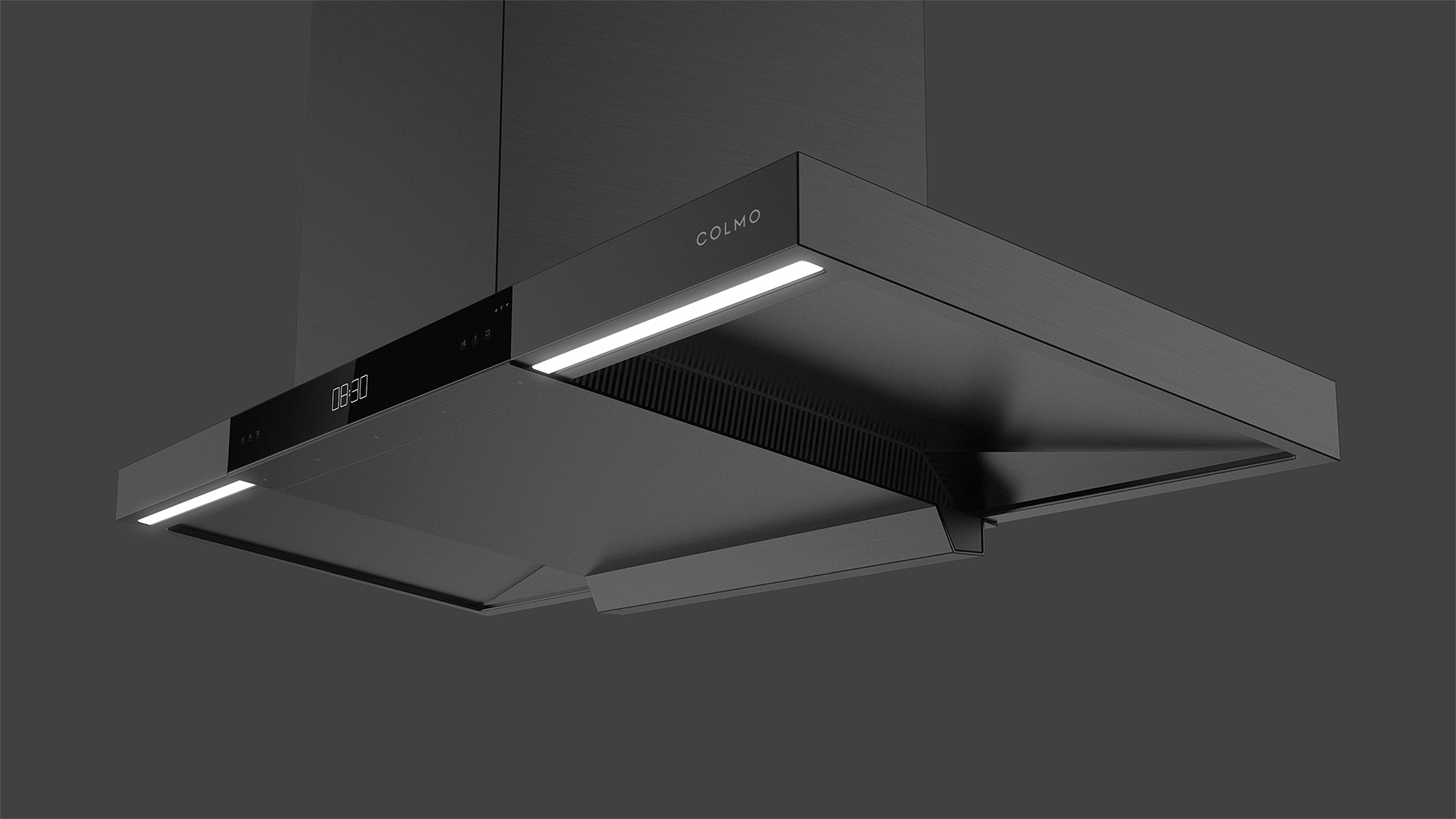


FINAL PRODUCT
The concepts and insights generated from this project informed the design of the Colmo Turing home appliance family and other appliances launched between 2019 and 2021. Above, you can see a selection of images from the IFA and the IF Design Award website, highlighting the recognition these designs received.